What Does a House Surveyor Actually Do? Survey Day, Step by Step — and What They Won't Touch
You've paid a few hundred pounds, the surveyor's visit is booked, and the estate agent calls it "just a formality." It isn't — the survey is the only professional inspection your biggest purchase will get before contracts. Knowing what the surveyor actually does (and deliberately doesn't do) turns the report from a rubber stamp into the negotiating and planning document it's meant to be.
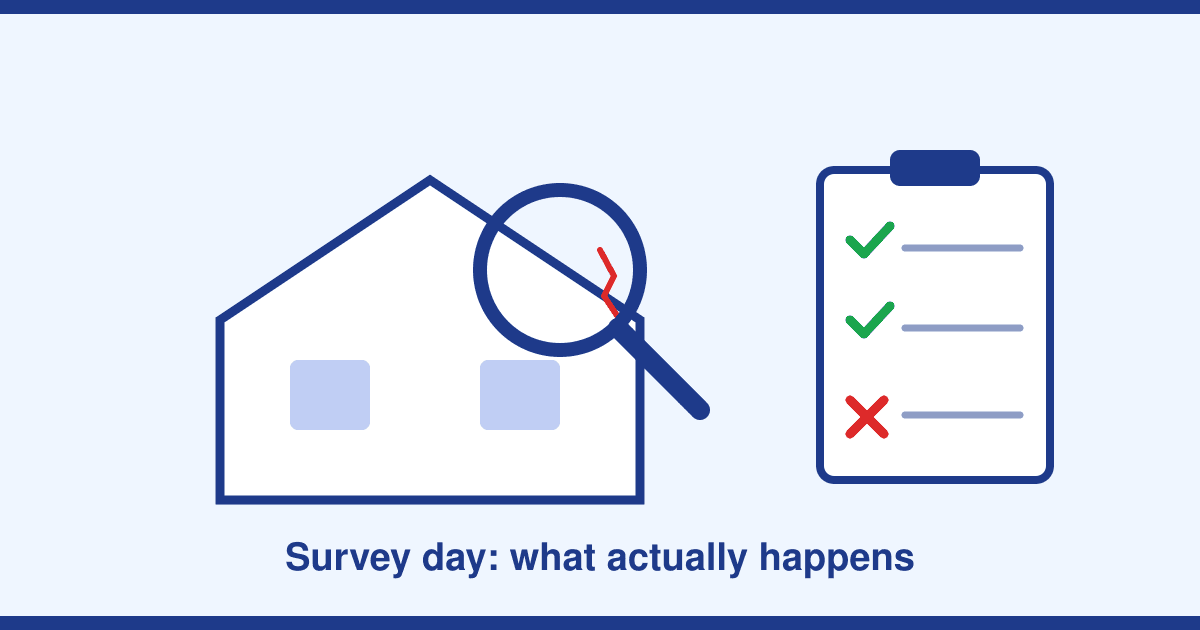
In short: A RICS Level 2 survey takes 2–4 hours on site — a visual, non-invasive inspection of everything accessible: roof, walls, ceilings, loft, windows, damp readings, timbers and outbuildings. The surveyor won't lift carpets, open walls or test drains — the report, arriving in 3–5 working days, grades what's visible with traffic-light condition ratings.
The inspection, hour by hour
- The outside first: roof coverings and chimneys (from the ground, with binoculars), gutters and downpipes, walls and pointing, windows, and permanent outbuildings — the weather envelope where expensive problems start.
- Room by room inside: ceilings, walls and floors for cracking, movement and staining; bathrooms and kitchens for leaks and ventilation; windows checked including whether they're double glazed.
- The damp meter walk: moisture readings at vulnerable points — chimney breasts, external walls, around plumbing — plus an assessment of damp-proofing, insulation and drainage arrangements (though drains are not tested).
- Timber checks: accessible joinery and structural timbers inspected for rot and woodworm.
- The loft: often the most revealing stop — roof structure, felt, insulation and any daylight where daylight shouldn't be.
What the surveyor deliberately won't do
The survey is visual and non-invasive — the surveyor won't lift carpets or floorboards, move heavy furniture, open up walls, or test drains and services. That's not corner-cutting; it's the deal: they're a guest in someone else's property, and the report grades what is visible and accessible on the day. This is exactly why the report language leans on "further investigation" — the surveyor flags the symptom (damp reading, cracked lintel, sagging roofline) and prescribes the specialist who can open things up. Whether you need this Level 2 inspection or the deeper Level 3 — with more time on structure and defects — is its own decision: Level 1 vs 2 vs 3 explained.
Reading the report like a professional
The report lands in 3–5 working days, traffic-lighted: condition ratings from fine (1) through needs attention (2) to serious/urgent (3). Three habits extract its value:
- Read every 3 with costs in hand: a "3" isn't automatically a deal-breaker — it's a repair bill to price and negotiate with. What happens after the survey finds a problem covers the renegotiation playbook.
- Don't skim the 2s: the "will need attention in time" items are your five-year maintenance budget, written by a professional for free.
- Phone the surveyor: most will talk through the report — ten minutes of "which of these actually worries you?" is worth more than the executive summary.
Squeezing more from survey day: tell the surveyor your specific worries when booking — the extension, the crack the vendor painted over, the damp smell in the back room. They inspect everything anyway, but flagged concerns get flagged attention in the report. And make sure the agent arranges loft access and keys to outbuildings — "could not be inspected" paragraphs are the survey money you wasted. What the whole exercise costs is in our survey cost guide; who to hire, in choosing a surveyor.
The bottom line
Two to four careful hours, everything visible from loft to gutters, a graded report in under a week — and clearly drawn limits at carpets, walls and drains. Brief the surveyor on your worries, guarantee access, and treat every rating-3 as a costed negotiation item rather than a verdict. Find vetted RICS surveyors near you here.
Frequently asked questions
A RICS Level 2 survey typically takes 2–4 hours on site depending on the property’s size and condition, with the written report arriving 3–5 working days later. Larger properties and Level 3 building surveys take longer.
Everything visible and accessible: roof, chimneys, gutters, walls and pointing outside; ceilings, walls, floors, bathrooms and windows inside; damp readings, insulation and drainage arrangements; accessible timbers for rot and woodworm; and the loft. Outbuildings and permanent outdoor features are included.
No — the survey is visual and non-invasive: no lifted carpets or floorboards, no opened walls, no moved heavy furniture and no drain testing. Where hidden problems are suspected, the report flags the symptom and recommends further investigation by a specialist.
Condition ratings run from 1 (no immediate concern) through 2 (needs attention in time) to 3 (serious or urgent). A rating 3 is a repair bill to price and negotiate with rather than an automatic deal-breaker — and the 2s double as a professional five-year maintenance plan.